


Our fascination with crime shows is one of television’s craziest phenomena. I ponder why we’re so addicted to these stories every time I scroll through the new on streaming section, only to find myself still perversely participating. What is it about watching the darkest corners of human behavior that keeps me coming back? The reckless danger that makes my otherwise normal life feel a bit more intense? Or is it when the line between a killer and a victim is so thinly drawn that I’m pulled into that complicated space between the two?
Whatever it may be, the last question has been my most recent obsession. The new hit drama series, Furious, is unloading a whole arsenal of crime show conversations on female serial killers, female rage, domestic violence, and the familiar victim tropes that have long defined women in the crime and thriller genres. And I just can’t help but talk about it. Read on for my full review of Furious, and why it’s easily become one of my favorite shows I’ve watched this year. Minor spoilers ahead.
What is Furious about?
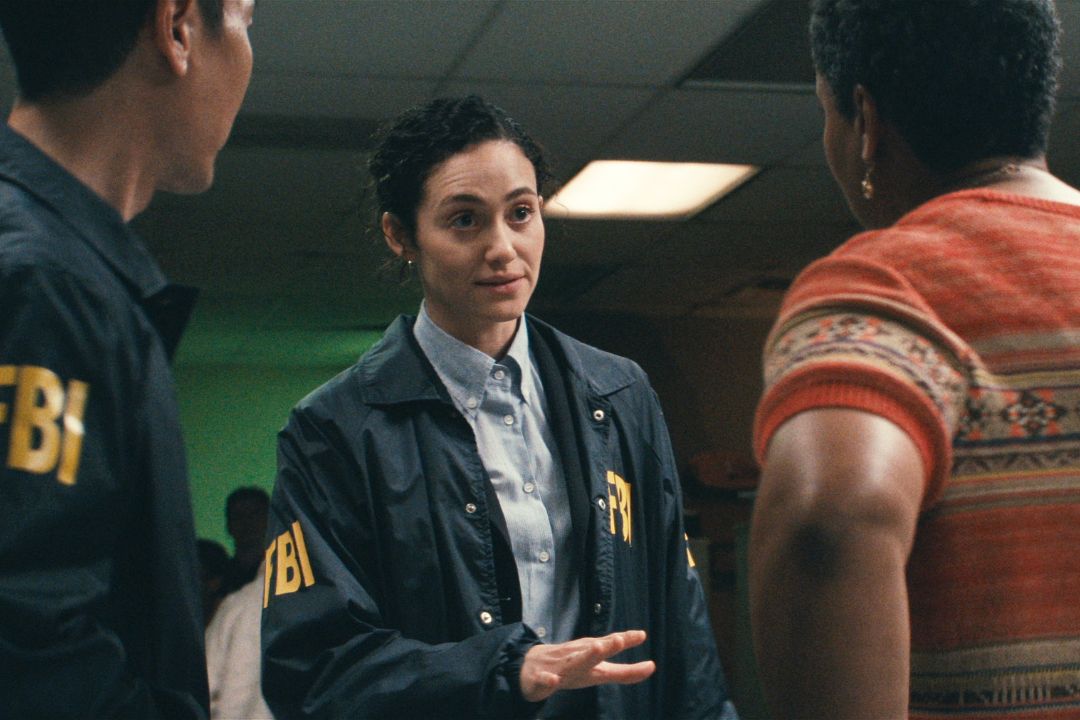
Furious follows FBI agent Alice Black (Shameless’s Emmy Rossum), who is called in to investigate the suspicious killings of lonely billionaires in modern-day New York City. Her investigation eventually leads her to uncover a mysterious, calculating serial killer named Catherine Grace (Lola Petticrew), whose endless supply of names, wigs, and masks makes her impossible to track down. The devilishly attractive cat-and-mouse setup in Furious easily pulled me in, but the dark, sinister past of its characters is the real force behind this addicting debut.
My review of Furious
The contrast between Catherine and Alice is insanely good
From the moment our FBI agent Alice Black first steps on screen, her eyes immediately tell us that there is something weighing her down. Revealed as a survivor of domestic violence in episode one, Alice’s past is one that she buries deep inside her. She tries everything to keep the word “victim” from defining who she is. But with Rossum’s gorgeously painful performance, you can still see that pain resting casually behind her facade. It’s one of the most complex cop portrayals I’ve ever seen.
Alongside Alice, you also have morally complex serial killer, Catherine Grace, at the center of the story. She is also desperate to free herself from victimhood, but her approach to the trauma of sexual assault is completely different than Alice’s. Catherine is seen hunting down and killing the people who assaulted her and killed her best friend. Even though Catherine is much louder with her grief, she still tries to bury it in her own ways, too. I loved the thematic exploration of coping with trauma we saw through these two characters. They highlighted the lack of language women are given as victims of domestic violence, showing how the divide between the “good guy” and a “bad guy” can be as thin as a needle point.
It had me rooting for a serial killer
While becoming a serial killer isn’t the best coping mechanism, women are often taught to be silent and not get angry about their pain. That messaging is exactly why you can’t help but root for the serial killer from episode one. Furious gives women a place to put the rage many of us feel towards sexual assault cases. It provides a space to get angry about the violent experiences of being a woman.
This is especially notable through Catherine’s tight grasp on what little girlhood she has left after her assault. From her signature sparkly crossbody to bedazzling her billionaire hit list and blasting Rihanna’s “We Found Love” while dancing in her room, there’s something genuine and girly about her serial killer portrayal. It’s as if this character is desperately trying to construct the teenage version of herself that was stolen from her by her abusers.
Little sinister details like this made Catherine’s character feel less like a serial killer who has abandoned all sense of self and more like a woman who is desperately trying to crawl back to it. Which I think a lot of women can relate to, in some capacity. Obviously, most of us aren’t dancing around our bedrooms while we have a drugged billionaire laying in the back of a van, but the simple want to retreat into the material things in order to feel connected to ourselves is a familiar feeling. It’s also one that made me weirdly hope nothing bad happened to the estranged serial killer.
A genre that often poses women as the victim is giving them the gun
In most crime dramas, you see a marginalized storyline that pushes women into the role of victim. But what’s so fascinating about Furious, and what immediately pulled me in as a viewer, is that it flips that trope entirely. Instead of asking what happens when a woman becomes the victim of violence, it asks what might prompt her to become violent herself—and, more importantly, what that violence looks like when a woman is pushed to the brink.
In the very first episode of the show, a hilarious but also troubled FBI detective Nora Washington—who works closely with Alice on the case—suggests that this question has actually been answered since the Greeks. Sitting down with Alice in a hospital room, Nora sets the tone of the entire show by giving her new recruit “the victim story.” Explaining the horrendous ways society fails victims of sexual violence and how this can be traced all the way back to Medusa through Greek retellings.
Medusa was once a beautiful human woman before she was assaulted in Athena’s temple by Poseidon. Unable to punish a powerful god, Athena decided to punish Medusa instead, transforming her into the stone-cold figure we famously know today. As Nora explains, the trauma, anger, and the punishment imposed upon Medusa eventually became the very things that make her a monster—emphasizing how society pushes victims of violence to become violent themselves. Whether internally or externally (as contrasted by our two primary characters). “Victims of violence are the most violent, don’t you think so?” Nora chillingly asks Alice.
Because society is often far more comfortable with women as victims than it is with women as violent, rageful creatures, what we often see in today’s age is the grieving wife or the dead girl whose found body kicks off an investigation. But where Furious comes in is that it asks some more intriguing questions like: what might prompt a woman to do such heinous crimes? And what do we do when a woman’s anger stops being quiet? What does it look like when that rage is holding the gun?
So, should you watch Furious?
Let’s not sugarcoat it. Absolutely. This is easily one of the most brilliant crime dramas I have seen in recent years. It discusses very sensitive and heavy information that is even more important and transcendent in this digital age.
If you love complex female characters and crime drama in general, Furious is a fascinating addition to a genre that has historically cast women in a very specific kind of victimhood. It’s also a fabulously paced thriller that dares to dive into more intriguing questions, like why someone committed a crime, rather than who. The show was also just renewed for a Season 2, so I will be patiently sitting with my popcorn bucket close by until then.

Madigan Will, Contributing Writer
As a contributing writer and former Assistant Editor for The Everygirl, Madigan has written and edited content across every topic under the digital media sun. As the oldest of four siblings, she brings a big-sister perspective to her work, helping readers discover new ways to maximize their everyday.
