

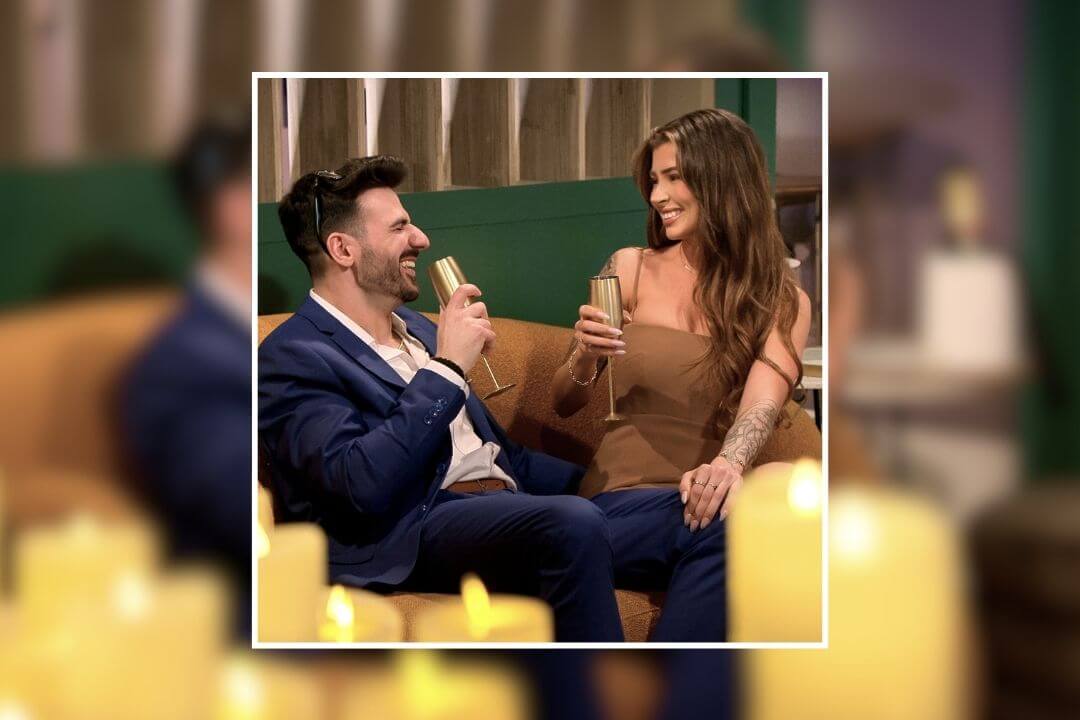
When I sat down to watch the most recent season of Love is Blind, I was, admittedly, not terribly excited. The show, even with its unhinged premise, had started to feel a little too predictable to me. If you’ve somehow managed to avoid watching the show since it aired in 2020, here’s how it goes: Cast members date each other through a literal wall, get engaged sight unseen, and, occasionally, get married weeks later. But this most recent season, the show’s ninth, gives something new. Warning: spoilers ahead.
No, I’m not referencing the whole “no successful couples” ending. I’m talking about the conversations around traditional gender roles that happened onscreen… and what they reveal about what’s happening offscreen. From the jump, the season features multiple couples early on in their courtships, floating some version of this question: “How do you feel about traditional gender roles in relationships?” While it’s a valid question, the fact that it came up so early and so frequently throughout the show and, ultimately, ended up being the demise of more than one couple is troubling.
To better understand what’s playing out, both on our feeds and screens and IRL, I went to the experts, Claire Fallon and Emma Gray, co-hosts of Love to See It, a podcast dissecting reality romance through a feminist lens, for insights. And they agree: The density of references to traditional gender roles on this season of Love is Blind feels unprecedented… and like a reflection of something larger. Are we reverting to outdated standards? Are women championed for finding a provider, instead of being the provider? Are we using unrealistic and unfair expectations to gauge compatibility? Ahead, we’re getting into what it all means.
Gender roles were discussed heavily between Love Is Blind couples
If this season of Love is Blind is any indication, the topic of gender roles plays a big part in finding your match these days. By the season’s finale, three couples remained together, and the women in all three of those relationships expressed their takes on gender roles. Ali Lima and Anton Yarosh, a couple who get engaged on the season’s first episode, are, seemingly, most in favor of traditional gender roles. “I’m the provider. I’m very old-school traditional,” Anton says in the season’s first episode.
Megan Walerius laments that she’s had a hard time finding a man who isn’t insecure about her professional success, but also shares that she’s an “anomaly” and believes in traditional gender roles in relationships. She gets engaged to Jordan Keltner, a single dad who is not as financially secure as she is—as that discrepancy seems to play a role in their eventual breakup. Then, there’s Kalybriah Haskin and Edmond Harvey. Both agree that they tend to reject traditional gender roles and crave “50/50” partnerships (a term that refers to relationships in which both domestic tasks and finances are split evenly).
While each couple differs slightly in their preferences, the sheer volume of these conversations is a little jarring. In light of conversations taking place on social media, though? I guess it shouldn’t be terribly surprising.
Gender role expectations are all over TikTok
I can’t seem to log on to TikTok without coming across a video about “provider men,” “feminine energy,” “the soft life,” and “high-value women.” The gist, according to this discourse? Men should be providers, paying all the bills and acting as the heads of their households; women should lean into their “feminine” and focus on nurturing.
If the old caricature of these gender roles is “man goes to work with briefcase while woman stays home to cook and clean,” TikTok’s 2025 answer to this seems to be “man grinds, taking on multiple jobs if necessary to make enough money to ensure his partner can spend her days doing pilates, shopping, and making TikToks boasting messages along the lines of ‘me at the pool on a random Tuesday because I married a provider’.”
“We are seeing more and more that women are valorized by audiences [if they] hold out for a richer man—that is seen as a way of valuing themselves.”
It’s an aspirational standard that seems to be affecting people’s relationship expectations, and that mirrors what’s happening on the show. In one scene, Ali and Anton are discussing plans for their lifestyle when Ali suggests that if neither of them feels like cooking dinner, they can outsource the task to their “private chef.” In the same conversation, Ali asks Anton if he makes enough money to support her financially, including funding her Master’s degree and Botox habit. And when he jokes he would need to work “100 hours a week” to make her vision a reality, she responds with “that’s a great answer.”
Social media is shaming women if they aren’t “high-value”
There’s a growing narrative that women who can afford this Botox-and-pilates lifestyle are “high-value women,” while others are “settling” for “bare minimum 50/50 men.” The reality? The economy is a hot mess, and most couples can’t make ends meet without two incomes, let alone afford these luxuries. It’s not just about these financial expectations, though. It’s also about shaming women and tying their worth to the amount of money their partners make.
“We are seeing more and more that women are valorized by audiences [if they] hold out for a richer man—that is seen as a way of valuing themselves,” says Fallon. “That does derive in large part from this discourse that a woman’s goal is to find the richest man to give them a soft life, and in return, they will bear him children and be beautiful and bake bread.”
On the show’s finale, there’s a clear reference to this when Ali’s friends question her just as she’s about to walk down the aisle. According to them, a “woman of [Ali’s] caliber” should think twice before marrying a truck driver. Ultimately, Ali says “no” at the altar, ending her relationship with Anton—and at the show’s reunion, she suggests that her cultural expectations around a man’s ability to provide financially played some role in this decision.
Fallon adds that Kalybriah, who spoke early on about rejecting traditional gender roles, caught some flak from audiences. “I saw a lot of people criticizing Kalybriah for saying she wanted a 50/50 partner, and saying that she’s basically a ‘pick-me’ and that she wasn’t expecting enough from her partner,” she says.
Non-traditional dynamics still make people uncomfortable
Elsewhere on the show, Megan finds herself in a different type of relationship-ending predicament. She’s wealthy enough to never work again, according to her onscreen fiancé Jordan. He, a single dad, is not, and that’s the root of their incompatibilities. Megan wants to travel spontaneously, enjoy fine dining, and play tennis during the workday; she has both the resources and the flexibility to do that. Jordan, who works a demanding job and has no financial safety net, does not. Ultimately, they break up because their lifestyles don’t align. “If I had a million gazillion dollars, I’d be doing whatever I wanted with you,” he says during their breakup.
“While the shifts we see play out on social media and in real life happen gradually, reality shows like Love is Blind act as a yardstick by which we can measure the evolution of romantic expectations and ideas.”
There’s no “right” way to approach money in marriage, but presumably, there could have been a way for Jordan and Megan to combine finances to even out that discrepancy. But, as Jordan mentions multiple times, he wants to be the provider in his family.
Many viewers, myself included, agree: Megan and Jordan are the onscreen couple with the most palpable connection. Yet, that isn’t enough. And while we don’t know every single factor that went into their breakup, it’s hard to watch snippets of it all play out and not wonder if they would have made it work had the financial imbalance been flipped. When watching this breakup, I found myself wondering: In 2025, the year of Taylor Swift and Travis Kelce’s engagement, are we still this culturally uncomfortable with women having the financial upper hand in a romantic partnership?
The shift back to traditional gender roles is undeniable
Obviously, gendered expectations and roles in relationships are nothing new. But, on reality TV, as Gray confirms, “this is the greatest number of front-and-center references [to gender roles] we’ve seen.”
I have, admittedly, been out of the dating game for a long time (14 years, to be exact). But I can say with confidence: I don’t remember this being such a thing. Sure, there’s always been a cultural expectation that men pay for dates in the courtship period, or that men do the proposing. But asking someone on a first date how they feel about traditional gender roles? I never encountered that. Yet on this season of Love is Blind, that’s one of the first ways contestants gauge compatibility.
Reality TV both informs and reflects culture. While the shifts we see play out on social media and in real life happen gradually, reality shows like Love is Blind act as a yardstick by which we can measure the evolution of romantic expectations and ideas. If this recent season tells us anything, it’s that a real shift is written all over the walls.

Zara Hanawalt, Contributing Writer
Zara Hanawalt is a freelance journalist and mom of two. She specializes in writing feminist, woman-centric content on motherhood, women’s health, work, entertainment, and lifestyle. She has written for outlets like Vogue, Marie Claire, Elle, Glamour, Cosmopolitan, Shape, Parents, and more. In her free time, she enjoys travel, cooking, reading, and a good reality romance show.
