

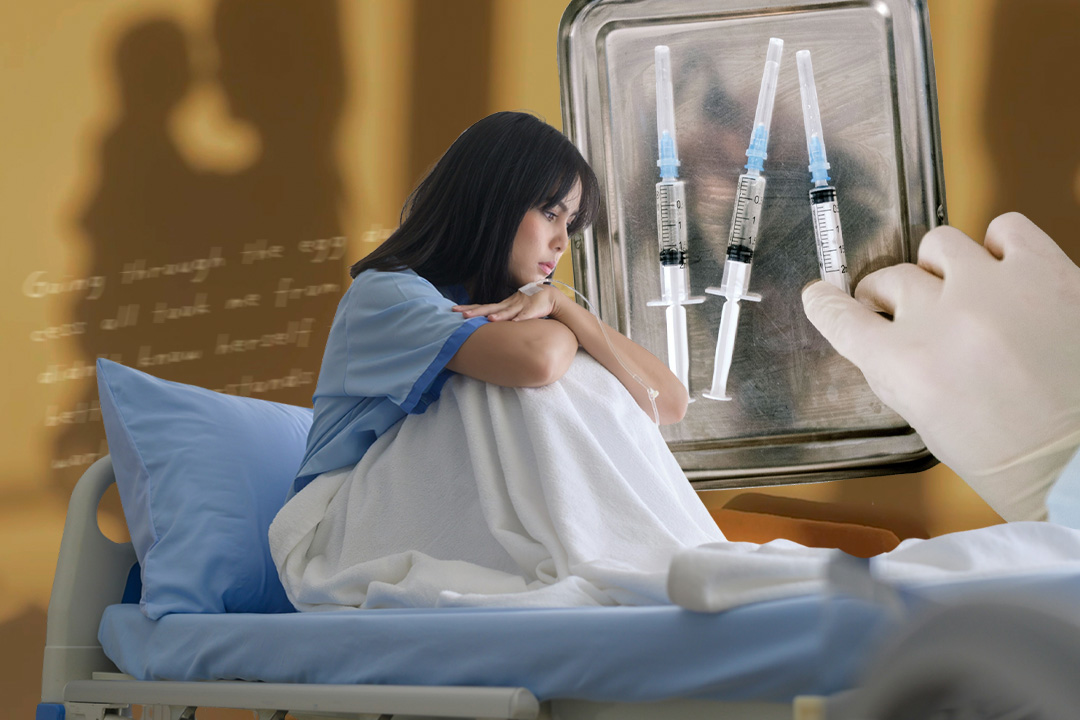
As I lay in the operating room counting down the seconds before the anesthesia kicked in, surrounded by a team of medical professionals, I felt a wave of various emotions: amazement at my body, proud of my bravery, and a fleeting sense of “how the f*ck did I get here?”
Like many experiences that end up being transformative, I never expected donating my eggs to be such a defining chapter of my life. It started as an unserious endeavor; I even viewed it as somewhat of a joke. Not the process itself—helping a family achieve their dream of having children is objectively beautiful—but having the nerve to fully send it, coupled with the thought of anyone actually desiring my genetic blueprint, felt surreal enough to make me shake my head and laugh.
Donating didn’t enter my consciousness until I saw a certain HBO series. If you’re tapped into pop culture, you may know what I’m about to confess: Sex Lives of College Girls was admittedly the catalyst for starting my donation journey. After losing her scholarship, Kimberly (Pauline Chalamet) paid for her tuition by doing so, and the way they portrayed it didn’t seem remotely intimidating: Watching her roommate give her injections in her ass while at a frat party, I thought, “That looks easy enough.” Before giving myself a chance to think about it too much, I did a quick Google search for fertility clinics near me and found one that looked friendly and legit (with clear photos of smiling patients and no Comic Sans anywhere).
The application process forces you to reckon with your identity
The initial interest form was quick and asked basic background questions, and I filled it out expecting to not hear back. But I did, almost right away: A coordinator reached out and asked me to complete the screening process, which was much more tedious. She sent over a document of over 100 questions, inquiring about my eating habits, hobbies, goals, and family’s medical history. It stunned me how deep they got: “What is your life philosophy?” one asked. “I’m 25,” I thought, sitting in my bedroom with my two fake plants, stuffed animals, and string lights. “I don’t have one of those.”
I realized I didn’t know much about myself in general. While I’d done a fair share of exploration (I did move across the country from Iowa to Los Angeles, and that requires at least some self-discovery), I was still trying to understand what I stood for and what I’d been through—my values, adversity, deepest ambitions. I worked at a safe, corporate job for a major digital publisher, writing about topics I didn’t care much about, yet I couldn’t imagine taking the risk of leaving. I’d never done therapy. Dating was a nightmare; I’d forced myself to make a Hinge profile, but responding to the guys who messaged me made me want to crawl out of my skin. Vulnerability was not my thing.
All of this to say: This application sent me into a bit of an existential spiral. “It’s wild that I can participate in giving another couple a child when I still feel like one myself,” I remember telling a friend. It hadn’t fully sunk in that this was serious, demanding, and had a real-life impact—for myself and the future families. But I was beginning to understand that it wasn’t going to be the cutesy little side quest I’d do for the plot and extra cash.
Along with the most intense questionnaire in existence, I had to submit dozens of photos of myself from multiple angles (humbling), sign a bunch of paperwork (boring), get genetic testing done (actually fascinating and something I urge you do), talk in-depth with an expert about my family’s medical history (kind of interesting), and pass a psychiatric evaluation (daunting).
“Going through the egg donation process took me from a naive girl who didn’t know herself to a grownup who better understands her body and the world it exists in.”
Something I didn’t consider was that it’s very possible to show up unprepared for the latter. Dealing with work, coming to terms with the fact that my best friend and roommate would be leaving the state soon, and simply trying to navigate how to take care of myself was enough to make anyone disassociate—particularly right before a professional was to make a judgment call on my sanity.
As I got on the video call, I did my best to come off as cheerful and normal but likely failed the harder I tried. I still vividly remember the last thing she asked me.
“What’s the most traumatic thing you’ve been through?”
I panicked, trying to think of something worthy of being deemed “traumatic” without being too heavy or making me sound unstable or unhealed. I could’ve responded with “this moment,” as the forced reflection into the metaphorical trenches of my psyche made my head spin and caused me to doubt if I was even ready to take this whole thing on. But I’d made it this far, so instead, I told her about the time my friend and I were driving down the interstate late at night after a concert, and my car got hit by a semi-truck.
“But neither of us got hurt,” I said. “Not even a scratch.” The real, honest answer would’ve been “my entire first relationship,” but I think that would’ve gotten me disqualified.
Writing all of this out, I’m astounded that anyone makes it to the actual donating bit of the process—and that’s not even getting into the physical and emotional demands of preparing your body.
You learn so much more about how your body works
At my high school, sex education was limited to one health class sophomore year. From what I remember, it mainly focused on STI education and how to prevent pregnancy using a condom. While limited, it was still better compared to most states in the U.S. that rely on abstinence-only programming.
According to SIECUS, only four states require sex education to instruct on menstrual health beyond teaching on puberty, and only five states have laws requiring comprehensive sex education (CSE). A study published by the American Society in January reported that of the women surveyed,
- 74% reported wanting children
- 59% felt uninformed about their reproductive health
- 69% reported varying levels of concern toward their future fertility
The authors Meredith L. Clements, Ph.D., Sean Sawicki, Ph.D., and Noelani Segree wrote that these results reflect the need for more emphasis on fertility education, especially for Gen Z and millennial women who are at peak fertile age.
Based on this data, I know I’m not alone in admitting that I’d been almost completely oblivious about fertility and my own reproductive health for 25 years. I didn’t know the complex ways the female body constantly transforms (especially when priming for pregnancy): how follicles grow, how the womb lining thickens, the number of eggs that develop in a cycle, the role the pituitary gland plays—I could go on. It was around this time that I discovered the four different phases women go through during a hormone cycle (menstrual, follicular, ovulation, and luteal), which I’d argue is the most basic of information.
Instead of learning about all of this early on in school, which would help explain to girls why they feel the way they do and the symptoms they experience throughout the month, the team of doctors and nurses at the fertility clinic were very gracious in explaining to me how it all works. For about two weeks straight, I drove myself to the office every few days for appointments: blood draws, ultrasounds, and lots of medication.
I found out that my ovaries are healthy and contain an average number of follicles that produce eggs as they should, something I would’ve never known unless I tried to get pregnant or was experiencing severe pelvic pain. Because of the hormonal stimulation you undergo during the egg donation process, your ovaries grow from around 2 to 3 centimeters to up to 10 centimeters by the time of retrieval, and my doctor went over their progress with me each time I visited. It was fascinating to see the inner workings of the healthcare system, and it made me realize that this should be the norm—being able to check your fertility and learn about your reproductive system firsthand empowers women to plan their future with certainty. That feels like essential healthcare, especially when the education system doesn’t provide the tools.
Being in a situation in which I was forced to confront my fertility also made me confront my body as a whole. I’d never paid more attention to it than I did during this period—I was looking at my literal insides almost every other day. It was a lot to take in, and it made me realize I’d been neglectful. But it also proved to me that what people say about everything being connected—mental health, hormones, movement, food as fuel—is real. If you ever find yourself wondering if how you’re feeling is wrong or if you’re overreacting, don’t. Listen to your body, and know what it’s telling you is real.
The weight of what you’re doing hits while administering the shots
When I divulge to people that I donated my eggs, the first thing they usually ask about is what administering the shots was like. The clinicians didn’t tell me much going into it, as they plan and adjust your schedule every few days and don’t tell you exactly what’s expected. I started with one per day, then worked up to two, then eventually three.
To put it simply (I’m not a medical professional, so don’t come for me), they prevent premature ovulation and stimulate egg development. If you’re familiar with IVF, it’s the same medication. As I was living by myself during this period of my life, I had no one else to help me (Sex Lives of College Girls led me astray there) or offer me moral support in person as I stuck a needle into my stomach over and over and over.
At first, they didn’t bother me much—I kind of felt like a scientist with my syringes and vials, and saying that I conquered them alone empowered me in a way. But that doesn’t mean I wasn’t scared. It finally hit me that I was going through with this; I was giving up a part of me, and backing out wasn’t really an option.
“It was fascinating to see the inner workings of the healthcare system, and it made me realize that this should be the norm—being able to check your fertility and learn about your reproductive system firsthand empowers women to plan their future with certainty.”
My family was supportive and knew what I was doing, but they were still nearly 2,000 miles away, and I didn’t want to cause them anxiety. I’ve always been independent (to a fault), and showing any kind of weakness never failed to make me physically recoil into myself. Staring at the shots lying out on my kitchen counter, though, I knew I had a choice: I could continue to be closed off, or I could try to lean on others. To give myself some comfort, I’d film myself whenever I had to give myself a shot and send it to my two close friends.
“I’m doing this on here because it’s giving me a sense that I’m not doing it by myself,” I said on video. “This is my life. I have medical needles stored in my fridge. Anyways.”
Moving into the second week of medication, the physical and emotional effects crept in: It became increasingly painful; I was bloated at all times, sore to the touch, fatigued, and felt generally kind of unhinged. By the end, I could barely stomach the thought of giving myself yet another shot. But each day, I got up, pushed the needle into my abdomen where bruises were forming, and went to work. It became exhausting: Shouldering the impossible expectations of femininity despite whatever is going on inside of you means there’s a constant dull ache in the background of your mind—but as women, we push through without leaving any clues that something’s not right.
“I don’t know if I can do this another day,” I told my phone five days before my retrieval procedure. “I don’t know how much more of this I can take. Up until a couple of days ago—totally fine. But now… I’m reaching my limit.”
You don’t always get to know what happens next
My retrieval went smoothly (with the exception of accidentally putting my trigger shot, which forces the final maturation of the eggs the night before, in the freezer and almost having a mental breakdown). It takes around 20 minutes, and they stick a thin needle through the vaginal wall and into the ovary sacs to suction the eggs out. I wouldn’t necessarily recommend looking up a video, but they’re out there if you’re curious.
When I woke up, I asked the nurse when it was happening, and she explained to me that it had already been done. My friend gave me a ride home, and I slept for a few hours. After that, I spent a few days unable to stand or walk properly—my stomach felt heavy and stretched whenever I stood, and eating only added to the discomfort.
Physical struggles aside, I felt pretty good. I was proud of myself and actually excited at the prospect of someone using my DNA to create another human being. I openly told people that I hoped the kids would reach out to me someday so I could see the different manifestations of my looks and personality. Would they have my freckles or laid-back nature? Would they love visiting new cities and reading books? Would they be cat people? Other than these selfish reasons, it’s hard to describe how it felt to participate in something bigger than myself: I held my breath hoping I’d helped make someone’s life better, and therefore the world a little better.
However, I didn’t hear anything from the clinic about how it went—how many viable eggs they got, if they’d been chosen, if any pregnancies occurred—which they had promised to inform me about in the beginning. I even ended up donating a second time, about three months later, and again, crickets. I felt left behind and slightly used.
Years passed. I took trips to Europe and Mexico, moved apartments, got into a relationship, and never received a single update. One day, I got curious and tried to email my coordinators, and the message bounced. The address could no longer be found. I looked up the clinic and learned that it had permanently closed. No one told me. “So… where are my eggs then?” I wondered.
“Thinking back to who I was when I sent my initial application makes me marvel at my lack of self: I was petrified at the thought of opening up, digging deeper, and deeming myself as valuable.”
I found the email of the egg bank that acquired the clinic, reached out, and they replied that they had my records and my eggs were in their central facility in Seattle. Since then, they’ve followed up multiple times asking if I was interested in completing another cycle.
I’m still not sure exactly how to feel—the donation itself was enlightening, and I felt cared for by the nurses and doctor while it was happening. But that seemed to end after walking out the door post-retrieval. I can’t help but see the parallels of how women, particularly mothers and soon-to-be mothers, are treated: Idealized for their ability to create life, and then discarded when society gets what it wants from them. Being aware means I’ll always feel a twinge of anger and disheartenment until women are truly cared for by the healthcare system and teachers and everyone around them, during all phases of life.
Thinking back to who I was when I sent my initial application makes me marvel at my lack of self: I was petrified at the thought of opening up, digging deeper, and deeming myself as valuable. Getting validation from other people, random strangers, and medical professionals confirmed that I did, in fact, have decent, maybe even exceptional, qualities. But it went beyond the donation—each time I told my story, I gained confidence in my power and reminded myself that I can do hard things. Going through the egg donation process took me from a naive girl who didn’t know herself to a grownup who better understands her body and the world it exists in. Now, I can even answer the question about my life philosophy (or at least one of them): Vulnerability takes strength, and it’s essential if you want to grow. And growth is always worth it.

Bryce Jones, Contributing Writer
Bryce is an LA-based journalist and freelance writer. She formerly worked as an editor at Better Homes & Gardens, covering topics ranging from lifestyle and food to entertainment and mental health. Her words have also appeared in Polyester, Cosmopolitan, Apartment Therapy, and more.
Feature graphic images credited to: Ebony Forsyth | Dupe, SHVETS Production | Pexels, Getty Images | Unsplash
