


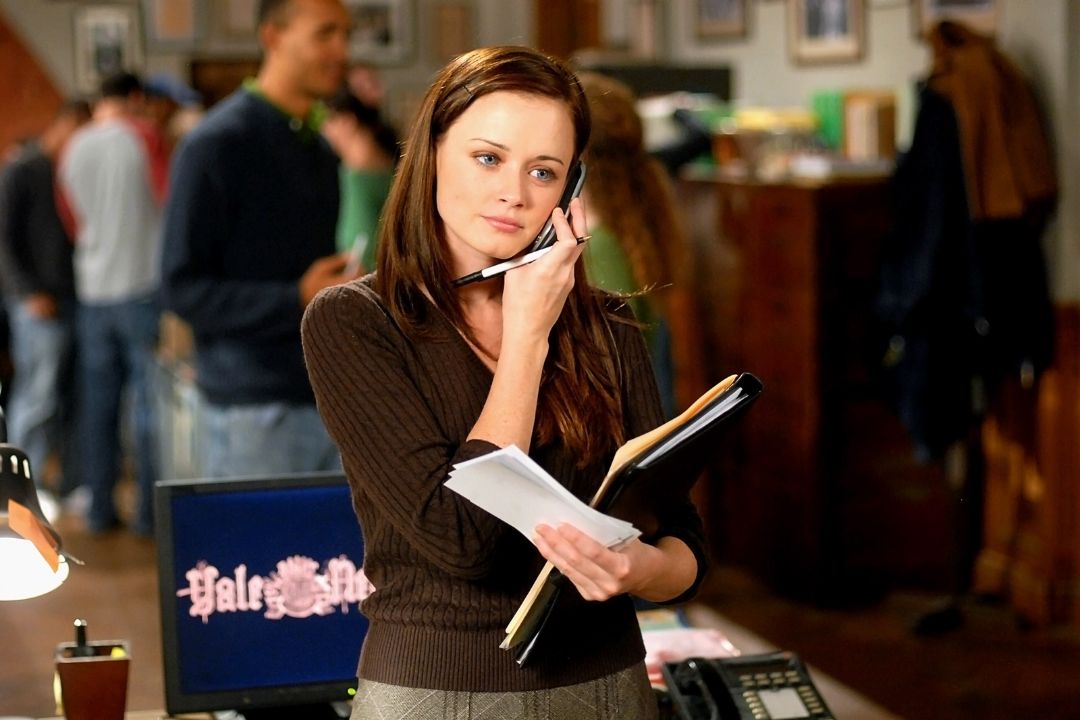
I’ll never forget when I saw the first ad for Gilmore Girls on TV. As a pre-teen girl who was an only child with a single mom myself, it immediately caught my attention. I gravitated toward a familial dynamic that mirrored mine. (Except the more-like-sisters part. My mom and I were definitely just mother and daughter.) But what solidified Gilmore Girls as my official new favorite show was that Rory was a lot like me: quiet, bookish, a bit awkward, and more concerned with her collegiate goals than partying and popularity. I had never seen a girl like that at the center of a show before, and it healed something in my teenage soul. Finally, a good girl. Finally, someone like me.
When Gilmore Girls first aired, I remember Rory being one of the most beloved characters on television. She was a girl with a strong moral compass who made high achievement cool again. But as new generations join us OG fans for our annual fall re-watch, Rory Gilmore has somehow gone from cherished comfort character to public enemy number one online. Whether it’s parody content calling Rory a terrible friend to Lane, berating her for sleeping with a married Dean (as if Dean were totally innocent), or criticizing her reaction to Mitchum Huntzberger’s critique (who wouldn’t crash out?), Rory Gilmore is now apparently the true villain of Stars Hollow. But the more I see people dissect Rory’s downfall, the more I realize the problem isn’t Rory—it’s society’s narrow idea of what a good girl should be, and how we punish her when she fails to fit it perfectly.
Rory made mistakes, but so would you
Here’s what we don’t talk about when it comes to being a good girl: it’s hard, really hard. (Ask me how I know?) The pressure to be perfect and adhere to the expectations of your “goodness” is exhausting. You are forced to maintain the same level of excellence no matter the circumstances, and every mistake is magnified under a microscope. When success and achievement are your M.O., the smallest of misjudgements are seen as the ultimate failure. Yet, it is often that pressure that leads to many of the missteps good girls end up making. Many people forget that good girls, just like anyone else, are figuring out life—and that often means making significant mistakes to do so. How else are any of us supposed to learn?
Rory is flawed from the beginning: lying to her mom about not wanting to go to Chilton because of Dean, accidentally staying out all night at her first school dance, and hurting Lane’s feelings while juggling her new school and first boyfriend. All mistakes a typical teenage girl makes (and most fans forgive her). In those early years, we still see her innocence—and her dedication to correcting mistakes and repairing damage proves she is the good girl she claims to be.
However, after season one, it’s as if Rory is out of mistake passes. Any slip-up from season two onward is critiqued with less and less grace. Missteps like the mishandling of her feelings toward Jess while with Dean, missing her mother’s graduation, and even the infamous “he’s MY Dean” scandal are often used as proof that Rory is an awful person rather than a flawed human being.
“Our culture usually loves a classic good girl story—until she grows up, makes mistakes, or dares to question the rules that made her likable in the first place.”
No, these choices aren’t excusable, but they are understandable given her circumstances, background, parental examples (or lack thereof), and the challenges of being a perfectionist people pleaser. Rory exhibits many of the flaws that most people would showcase under the same circumstances. No, we wouldn’t necessarily make the exact same mistakes, but we would certainly make some questionable decisions if we were navigating similar situations under similar pretenses. I, for one, would not know how to handle feelings for multiple guys at age 17, especially if I didn’t have healthy relationship examples to model. And even at age 35, I struggle to put friendships first when my to-do list is sky-high. How Rory managed any kind of social life while grinding away at Chilton, I’ll never know.
This is the point of shows like Gilmore Girls and characters like Rory—to showcase the relatable messiness of life, relationships, and unhealed wounds. To remind us just how deeply good we are despite our missteps, misjudgements, and emotional baggage. Yet, because Rory personifies the perfectionist good girl, the flaws most characters get away with are more scrutinized.
Why we love then loathe the good girl
Our culture usually loves a classic good girl story—until she grows up, makes mistakes, or dares to question the rules that made her likable in the first place. Then suddenly, she’s the villain. Even Lane, Rory’s best friend and another certifiable good girl, is getting her own share of heat. Though many want justice for how her story turned out, I’ve seen commentary criticizing her choices to marry Dave and become a mother, as if her ordinary life somehow lessens her worth or demeans her potential. (I could go on about this, but I’ll save that for another article. Yes, justice for Lane Kim, but also, maybe she’s really happy and that’s okay.)
From childhood, girls are socialized to be kind, modest, high-achieving, and accommodating. Rory embodies this quite well. She’s the ideal daughter, student, small-town sweetheart, and in the eyes of many in her life, she can do no wrong. This is something that even Rory dislikes about her perceived perfection. She often wants people to see that she is flawed and should be held accountable for her actions. (She took just as much accountability for the car accident with Jess, remember?) But, because the village that surrounds her does feed into her perfection a bit too much, many critics think this causes Rory to become entitled, spoiled, and an overall trash human being.
This is where I disagree. This is where I see society turning on the good girl because she is flawed. Society resents that, and here’s why: Rory reminds us of ourselves. And it’s much easier to hate her than to look at the mirror she is holding up to us. Rory’s deeply flawed humanity reminds us that we are all just as deeply flawed. She reminds us of that time when we let a relationship, a job, or a goal stop us from being a good friend. She exposes our selfishness amidst our desire to be selfless. She uncovers the everyday mess we all pretend isn’t there.
“The hate we direct at Rory is really about ourselves: she’s the good girl who could slip up, while we were never given the same grace.”
Rory is proof that everything we were taught about being a good girl isn’t necessarily true. We thought doing everything “right” would spare us heartbreak, failure, and insecurity. Yet here we are—having done all the things we were supposed to—still dealing with heartbreak, failure, and insecurity. Maybe we’re even a little envious because Rory got to make mistakes and move on, while our missteps felt heavier—or worse—we never even got the chance to take those risks. Rory was allowed to be human in ways we still struggle to allow ourselves, no matter how many self-help books we’ve read.
Rory isn’t the villain—society is
When a good girl stops being a good girl, we get uncomfortable. Angry, even. Because we never allowed ourselves to stop being the good girl. We stopped just short of that crash-out. We weren’t afforded the opportunity to simply take that semester off when we were drowning in self-doubt and failed classes. We didn’t get the chance to fail without judgment. We had to keep up that good girl persona because we knew we would be eaten alive otherwise, and it’s not fair that Rory—regardless of being a fictional character—got to let her good girl persona falter a bit without losing love, support, or her sense of worth. So, we dish it out to her on the internet. We attach her mistakes to her person rather than allow them to represent her (and our) humanity. The hate we direct at Rory is really about ourselves: she’s the good girl who could slip up, while we were never given the same grace.
The expectations we place on good girls are really an extension of the expectations society places on us—and they’re unattainable, unforgiving, and serve as a rubric for stripping our humanity from us. And that hurts. So, we take that hurt and dish it right back to every girl who dares to vulnerably mess up in the face of those demands. Rory Gilmore is not the problem—the problem is that society has never let good girls be human. She deserves better. And so do we.
But let’s also remember this: Rory is a fictional character. She’s the product of writers, episodic time constraints, and plot holes. Gilmore Girls is also a product of its time—the early 2000s. Criticizing this show with a 2025 lens will only take us so far. And, if we’re not careful, we will allow our analysis to overshadow the comforting hug the show gives us, which is the whole reason we come back to Stars Hollow every year. Every single character in Gilmore Girls is wonderfully complex, flawed, and humanly imperfect. That’s what makes them relatable and enduring. That’s part of the warm embrace this show provides us. There’s a reason we keep coming back: because in a world that demands perfection, Stars Hollow reminds us it’s okay to be messy, to be flawed, and to still be loved.

Caroline Sumlin, Contributing Writer
Caroline Sumlin is a writer, author, and content creator specializing in topics ranging from self-worth, lifestyle, wellness, motherhood, education, society, and culture. Caroline received her Bachelor of Arts degree in Journalism from Howard University in Washington, DC. Driven by her passion for freedom and justice, Caroline crafts articles that urge readers to reflect more deeply and critically about themselves, their lives, and the world around them.
