


Healthy eating doesn’t start in the kitchen; it starts at the grocery store. In fact, most of the decisions that determine what you’ll eat all week happen long before breakfast, lunch, or dinner ever hits your plate. The foods you buy (or don’t buy), where you spend your grocery budget, and even the route you take through the store can make healthy eating feel effortless–or nearly impossible.
I didn’t always know that. For years, grocery shopping felt overwhelming. I’d leave the store having spent far more than I intended with no clear meal plan, a fridge full of random ingredients, and somehow nothing to eat. But once I learned a few simple grocery-shopping strategies, everything changed. My meals became healthier, my food waste plummeted, and I actually started saving money. Whether your goal is to eat more protein, improve your gut health, reduce inflammation, or simply make healthy eating feel easier, these are 10 grocery store hacks wellness girls swear by.
10 Grocery Store Hacks Wellness Girls Swear By
1. They make a thorough shopping list beforehand
Going up and down the aisles without any semblance of a grocery list can be costly and time-consuming. Not only will putting a shopping list together save you from overbuying food that ends up being thrown out, but it will also help you determine what items you can use for multiple meals, especially if you are buying for just yourself. Plus, you’ll be more efficient while you shop and when you meal prep for the week.
If you dread creating yet another list, try an app that’ll do the work for you, like AnyList or Mealime. You can also ask ChatGPT to create a customized meal plan based on your goals, dietary preferences, budget, and even what you already have in your fridge. It can then turn that meal plan into a complete grocery list organized by category, helping you avoid impulse purchases, reduce food waste, and make sure everything you buy has a purpose (think of it as having a personal meal planner and shopping assistant in your pocket).
2. They never shop on an empty stomach
We’ve all been there: You’ve shut your laptop for the day and you’re coming up on dinnertime, but you realize you have no food in the house. You make a mad dash to the store only to end up with odds and ends (read: sugary and salty snacks for instant gratification), rather than cohesive ingredients you can actually use to throw together a well-balanced supper. To avoid a futile trip to the store made up of mostly unhealthy items (and a blood sugar rush), try to schedule your grocery shopping after you’ve had a nutrient-dense meal (your wallet will benefit, too).
3. They know in-season produce is nature’s capsule wardrobe
Rather than forcing the same foods year-round, wellness girls work with what’s naturally abundant in each season, making meals feel fresher, more exciting, and often less expensive. Eating seasonally supports your body’s needs, tastes better, is more nutritious, and is cost-effective. There’s a reason a summer tomato tastes dramatically better than one you buy in January; produce that’s harvested in season is often picked closer to peak ripeness, which can translate to better flavor, texture, and nutrient content. Purchasing from your local farmers’ market instead of a chain grocery store is a surefire way to find local and sustainable items, but even if you’re shopping at your local grocery chain, Whole Foods, or Trader Joe’s, opt for organic in-season foods, as they’re likely the most local and will still contain similar benefits if they’re not. Research what is locally in season in your area using a resource like The Seasonal Food Guide, and then add to your trusty grocery list.
4. They buy the rainbow
Having the same kale salad every day? One of the biggest misconceptions in wellness is that healthy eating means finding a handful of “good” foods and eating them every day. In reality, your body benefits far more from diversity than repetition. For optimal gut health, it is recommended to eat at least 30 different plants each week (that includes dry herbs, spices, and garnishes too!), so your shopping cart should reflect that. A diet made up of diverse plants means you consume a wide range of micronutrients and fiber necessary for overall health and optimal gut function (the more diversity you consume, the more species of bacteria that will be present inside your gut and the better your gut health).
Challenge yourself to make your grocery cart look like a box of crayons. Deep purple berries, bright orange sweet potatoes, red bell peppers, dark leafy greens, white mushrooms, yellow squash—each color contains different plant compounds that support everything from gut health and immunity to brain function and healthy aging.
5. They count ingredients, not calories
The healthiest women know how to read a nutrition label, but they also know health is about an abundance of nutrients, not limiting calories. We’re talking about understanding food quality; for general health goals, the ingredients list matters more than the nutrient breakdown. Product ingredients are listed by quantity—from highest to lowest amount—so the first ingredient is what the manufacturer used the most. If they include refined grains, a type of sugar, or hydrogenated oils, it’s a safe bet the product is not as nutritious as you may think. Choose packaged goods with ingredients that are mostly (or completely) whole foods (read: ingredients you might have sitting around your kitchen, rather than something that has to be made in a factory). If you‘re unsure about a product and can’t pronounce half its ingredients, check if there’s an alternative with a simpler ingredients list.
Even if an item is marketed with traditionally “healthy” adjectives like natural, gluten-free, or sugar-free, there could be other not-so-great ingredients lurking in them, like added sugars or chemicals. Front labels that make health claims can be misleading, making you believe a product is healthier than the same product that doesn’t have the same marketing buzzwords on its packaging (when it’s in fact not). The healthiest women don’t obsess over calories or macronutrients, but they are fluent at reading an ingredients’ list to know what’s the hype and what’s not.

6. They utilize the frozen section
You may think that the frozen section is all processed foods and desserts, and therefore a wellness girl couldn’t be caught dead shivering through the aisle. But the frozen section actually keeps crucial hacks to eat healthier while saving time and money. It’s a fair assumption that fresh produce is best, but research has shown that frozen fruits and vegetables can have just as many vitamins—or sometimes more—as their newly-harvested counterparts. Frozen produce is often cheaper than fresh and obviously lasts longer, so, you can always keep it stocked for those times you forget spinach for a recipe or don’t have time to make it to the grocery store (veggies and fruit can last up to a year, depending on what they are).
Social media loves overflowing farmers’ market hauls and perfectly arranged produce drawers, but the healthiest people aren’t healthy because they never run out of fresh vegetables—they’re healthy because they have systems. Keeping frozen berries for smoothies, frozen spinach for pasta sauces, or frozen mixed veggies for busy weeknight stir fries makes it much easier to eat nutrient-dense foods consistently, even when life gets hectic.
7. They invest in grass-fed and organic meats and dairy
Many of us spend more time comparing protein powders than we do the actual protein on our plates. But if you’re eating animal products, how that animal was raised may matter just as much as how many grams of protein you’re getting. Not all animals are treated or fed the same; it’s important to select animal products carefully. Conventional meat and dairy, such as bacon, “fake meat” products, and milk, may include added hormones and preservatives that can disrupt gut health. On the other hand, animal protein from pasture-raised chicken, grass-fed beef, wild-caught fish, and other organic sources contains higher nutrients and doesn’t cause inflammation as we see in processed farm-raised meat.
Yes, it is more expensive to buy organic and grass-fed, but this is one of the areas most experts agree is worth splurging on. If your grocery budget is limited, many nutrition experts recommend prioritizing quality over quantity when it comes to animal products. Instead of buying more meat, consider buying less overall and choosing higher-quality options when possible.
8. They know their splurges versus savings
The healthiest shoppers aren’t necessarily the ones spending the most money, they’re the ones spending intentionally. Since wellness girls think of grocery shopping like building a capsule wardrobe, they know you don’t need every luxury item; you just need to know which pieces are worth investing in and which basics can come from the budget rack. Healthy eating is actually about knowing which purchases offer the biggest return on investment for your health and where you can save without sacrificing quality. Consider paying more for organic and grass-fed meats, dairy, the dirty dozen (the highest pesticide-sprayed crops, so you’ll ideally want to buy them organic), and high-quality oils (think: avocado and extra virgin olive oil).
As far as where you can save, buy nuts and seeds in bulk, frozen or canned seafood, opt for frozen or canned produce (canned beans, hearts of palm, olives, etc. are typically under $4) and generic store-brand pantry staples like dried pasta or broths.
9. They plan their snacks at the grocery store too
When meal prepping, we typically think to only plan breakfast, lunch, or dinner ahead of time, but when 3 p.m. rolls around and you have nothing prepped to tide you over, you’ll wish you planed for snacks too. We typically think of “snacks” as packaged foods high in sugar or added sodium. But the easiest way to eat healthier isn’t to have more self-control; it’s to make the healthy choice the easy choice. If washed berries, yogurt, nuts, or hummus are already in your fridge, you’re much more likely to reach for them than if they require prep when you’re already hungry.
Plan for snack time when you’re grocery shopping: load up on jerky, hummus with crackers or vegetables, hard-boiled eggs, mixed nuts, Greek yogurt with berries, or cottage cheese. And if you’re jonesing for something to munch on that’s crunchy, salty, or sweet but want to lean on the healthier side, check out these healthier swaps for all your classic favorite snacks.
10. They shop for their bodies
Grocery shopping and nutrition is not one-size-fits-all. When it comes to choosing items at the grocery store, listen to your body above all other advice. Foods that are considered “healthy” may not make you feel good. Figure out what works and doesn’t work for your body, and shop according to that information, rather than what’s trending on TikTok. Experiment with new produce, grains, fats, and other foods that are full of nutrients, but then check in with your body to see how it responds. Add the foods that only give you satisfaction, improved energy and mood, and joy to your cart, and for the foods that fall short, you know what to do: ditch ’em.
Think of your grocery cart as a reflection of what you’ve learned about yourself. Maybe your best friend feels amazing on a high-protein breakfast while you need more fiber and prefer fresh fruit and light yogurt. Maybe TikTok swears by cottage cheese, but dairy doesn’t make you feel good. Wellness becomes much simpler when you stop trying to eat like everyone else and start paying attention to what actually works for you.
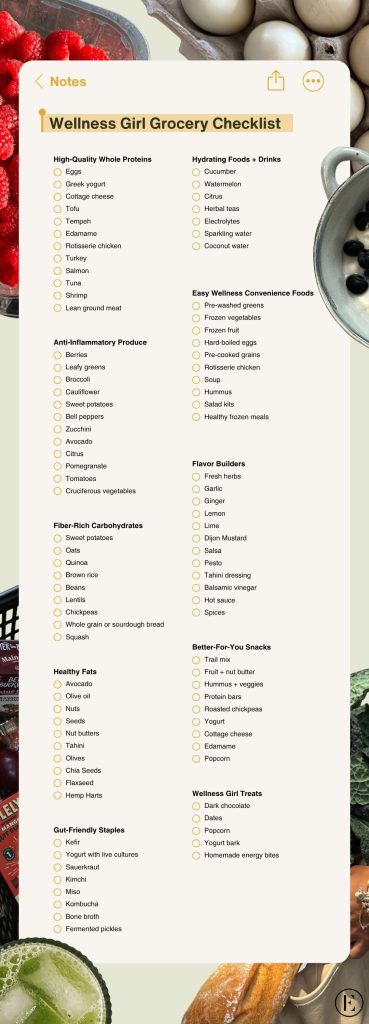
The Wellness Girl Grocery Checklist

Katherine Chang, Wellness Staff Writer
Katherine Chang is The Everygirl’s Wellness Staff Writer with over five years of experience in the health and wellness space. She navigates the latest wellness topics and trends through expert interviews and studies, and she’s always first in line to try them firsthand.

Calissa Kirilenko, Breathwork Facilitator & Contributing Wellness Writer
Calissa is a Wellness Writer for The Everygirl who specializes in covering subjects surrounding mental health, meditation, and self-care. She is also a Certified Breathwork Facilitator and works with clients to heal through the power of their breath.
