



Whenever I go to Italy, I come home feeling lighter, more energized, and honestly healthier. Which logically makes no sense–I have pasta, gelato, wine, and cheese on repeat? The late nights, heavy meals, few too many cocktails, and lack of a regular exercise routine that usually accompany vacations typically leaves my body feeling blah. By all accounts, I should return feeling sluggish… but I always leave Italy feeling healthier.
If you’ve ever wondered why people seem to thrive in Italy despite eating foods that many wellness trends tell us to avoid, you’re not alone. In fact, “Why do I feel better in Italy?” has become a TikTok trend. Despite popular nutrition trends demonizing Italian staples like pasta and pizza, Italy is one of the world’s healthiest countries. While there are likely many factors that contribute (namely having to do with fresher ingredients and better agricultural practices), I noticed something else: Italian women approach wellness completely differently than we do in the US. You don’t have to live there to reap the benefits of the Italian lifestyle; here are six Italian girl wellness hacks I picked up from women in Italy that I’ve started incorporating into my life since my first trip to Italy. Trust me—they make a huge difference.
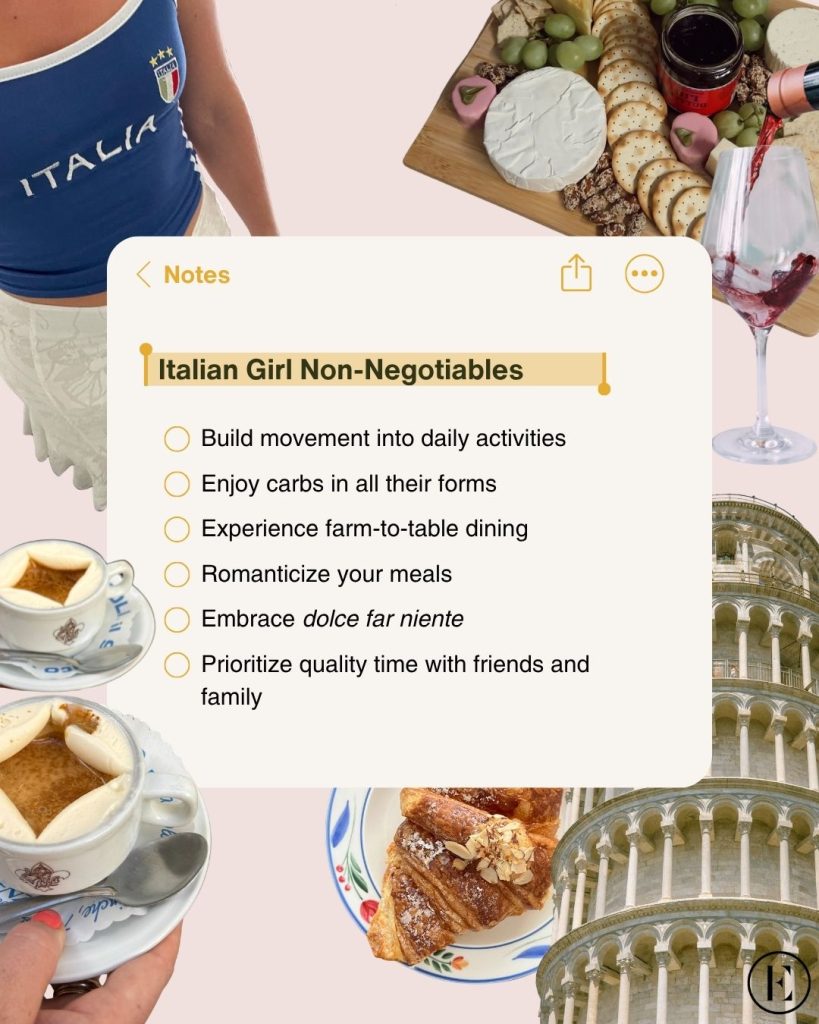
6 Italian Girl Wellness Habits
1. Go on a walk every evening
Italians know better than to take one HIIT class and stay sedentary at a desk or their couch the rest of the day. Rather than a designated workout time, they incorporate physical activity into their daily routines, like walking to the store and tending to their gardens. In Italy, I didn’t maintain my usual structured workout routine, but I walked everywhere. Many of the Tuscan towns we visited didn’t allow cars within the city, so we explored the picturesque cobblestone paths by foot. I easily reached 10,000 steps a day, and I noticed walking after eating improved my digestion.
Although it’s challenging to walk as much as we did on vacation on a daily basis (I am unfortunately not walking distance from every grocery store, restaurant, cafe, or friend’s house like they might be in the Italian towns I visited), my husband and I did bring one habit home with us: la passeggiata. La passeggiata is the Italian ritual of going on a leisurely evening stroll. The goal of this walk isn’t to break a sweat like we think of designated exercise time, but rather to catch up with loved ones after a day at work. Looking at this evening stroll as a moment of reconnection rather than exercise makes it so much more enjoyable (read: more likely to stick to), while still getting the same amount of steps. TL;DR: Exercise does not have to be a chore to check off your to-do list, it can be the most enjoyable part of your day.
2. Enjoy carbs with every meal
Before Italy, I’d bought into the misconception that carbs are the enemy, so my meals would solely revolve around veggies and protein, leaving me emotionally and physically unsatisfied. The lack of enthusiasm I had for my “healthy” meals and the intense restriction I put on myself set the groundwork for major carb cravings and late-night cookie binges.
When we got to Italy, I removed all of the restrictions I had set around food. I was determined to allow myself to fully experience all the cuisine Italy had to offer. I started my mornings with a ham and cheese croissant with a big bowl of fruit, and I ended my days with a bowl of pasta and a glass of wine. Contrary to what diet culture tells us, I didn’t sluggish and bloated. Rather, my energy improved, and allowing myself to indulge in foods I used to deem off-limits eliminated the urge to binge eat.
Of course, the ingredients were likely fresher and easier to digest than many ingredients used in the US, but the reminder that carbohydrates are not in fact the lesser macronutrient remains an important reminder no matter what country you’re in. Now, I focus on cooking meals that make me feel my best physically and emotionally, which means including carbs at every meal. If you’re still worried that carbs will wreck your wellness goals, you should know that dietitians have debunked the myth that carbs cause weight gain. In fact, restricting food groups in order to lose weight may actually backfire. When entire food groups or macronutrients are excluded, there is a higher chance of constipation, energy loss, reduced bone strength and density, and low immunity.
3. Be aware of where your food is sourced from
The Tuscan countryside is scattered with agriturismos, working Italian farms offering visitors dining and lodging. The one we stayed at produces its own wine that we enjoyed nightly. Others we visited produce their own olive oil and serve meals using ingredients grown on their property or sourced from nearby farms. These meals often included homemade pasta with a simple sauce, local veggies, cheeses, meats, and truffles they’d hunted and gathered that morning.
As Americans, we typically don’t often stop to think about the quality of food we eat or where it comes from. We typically look for hyper palatability and convenience first and foremost, which leads to an overconsumption of salt, sugar, and unhealthy cooking oils. However, in Italy, local ingredients take center stage at every meal. Since the ingredients are so fresh, meals are flavorful without the need to add filler ingredients, which leads to both a tastier and healthier diet. I now focus on purchasing as many ingredients as I can from my local farmers market, and it has encouraged me to get more creative in the kitchen and drastically increased our fruit and veggie consumption.
4. Romanticize your meals
If you’re anything like I was, you scroll Instagram while eating breakfast, work on your computer while shoveling down lunch, and cue Netflix at the end of the day for dinner. Italians approach eating differently. You won’t find them eating lunch on the go or staring at a TV screen during dinner. Instead, Italians have long lunches and dinners, often with many courses, taking the time to savor each bite and catch up with friends.
While it may be second nature (and tempting!) to multitask while you eat, it can work against your health goals. Research has shown that looking at screens while eating can cause overeating. Plus, it gets in the way of you being fully mindful to allow your digestive system to relax. I don’t always have the time to dedicate an hour of enjoyment to each meal like I may on my Italian vacations, but I have started romanticizing my meals. This means no more screens at mealtime, focusing on what I’m eating, and occasionally implementing an aperitivo and antipasti (think: enjoying a glass of wine with a meal or having a gut-healthy appetizer like pickled vegetables before dinner). When the weather is nice, I’ll dine alfresco, and when I dine inside, I light a candle and turn on my favorite Spotify playlist.
5. Embrace dolce far niente
I occasionally fall into the productivity trap. Eight-hour workdays easily become 12-hour workdays, and Saturday mornings turn into an opportunity to squeeze in a couple of hours of writing. While I love my job, overworking leaves me uninspired, tired, and depressed. But after returning home from my trip to Italy, I noticed both my energy levels and excitement for my career rise.
Other countries are much less productivity-driven. Italians prioritize and value il dolce far niente—which means “the sweetness of doing nothing.” Taking the time to appreciate long lunches, evening strolls, and kicking back with a few friends and a glass of wine aren’t occasional treats for the natives—they’re the norm. This balanced approach to life can help reduce stress, ultimately making you happier and more productive when you need to be. I now prioritize little pockets of relaxation throughout my day, which can look like reading a good book or ditching my laptop for a snuggle session with my dog. I have to actively remind myself I do not have to earn rest or pleasure with productivity–it is a daily priority.
6. Your community determines your health
Longevity isn’t purely determined by genes, and your health isn’t merely a result of your diet and exercise routines; the social connections you maintain can play an equally important role. Research such as a 2017 study confirms the importance of community for wellbeing: fostering strong social connections reduces stress, enhances mood, and increases longevity. Read this to learn more about why your community and relationships may impact your health more than diet and exercise.
While many other countries and cultures also value community and family, I noticed Italians have a much different approach to their family life and community than we do in the US. Take Sardinia, Italy (a Blue Zone BTW, meaning one of the longest living populations on the planet). Sardinians put family first and gather every afternoon to laugh with each other. Not the weekends, not holidays, but every day. Research on the Blue Zones found this was one of the key factors contributing to their notable longevity. Whether it’s la passeggiata or a family dinner being the most important moment of the day, Italians prioritize weaving a strong sense of community into their daily lives.
As for how I adopted the Italian way of socialization into my own life, I’m much more mindful about prioritizing walking dates with my husband, alfresco meals spent with friends that last hours on end, and striking up conversations with my yoga students after class, rather than looking at pleasure time with people I love as the leftover time after work is done.
Want more?
READ: Your Ultimate Guide to an Italian Girl Summer
READ: Everything You Need to Master Italian Girl Style

Michelle King, Contributing Wellness Writer
Michelle King is a midwest-based writer, content strategist, and yoga instructor. She received her BA in English from the University of Missouri and works as the Content Marketing Manager at Booyah Advertising.
